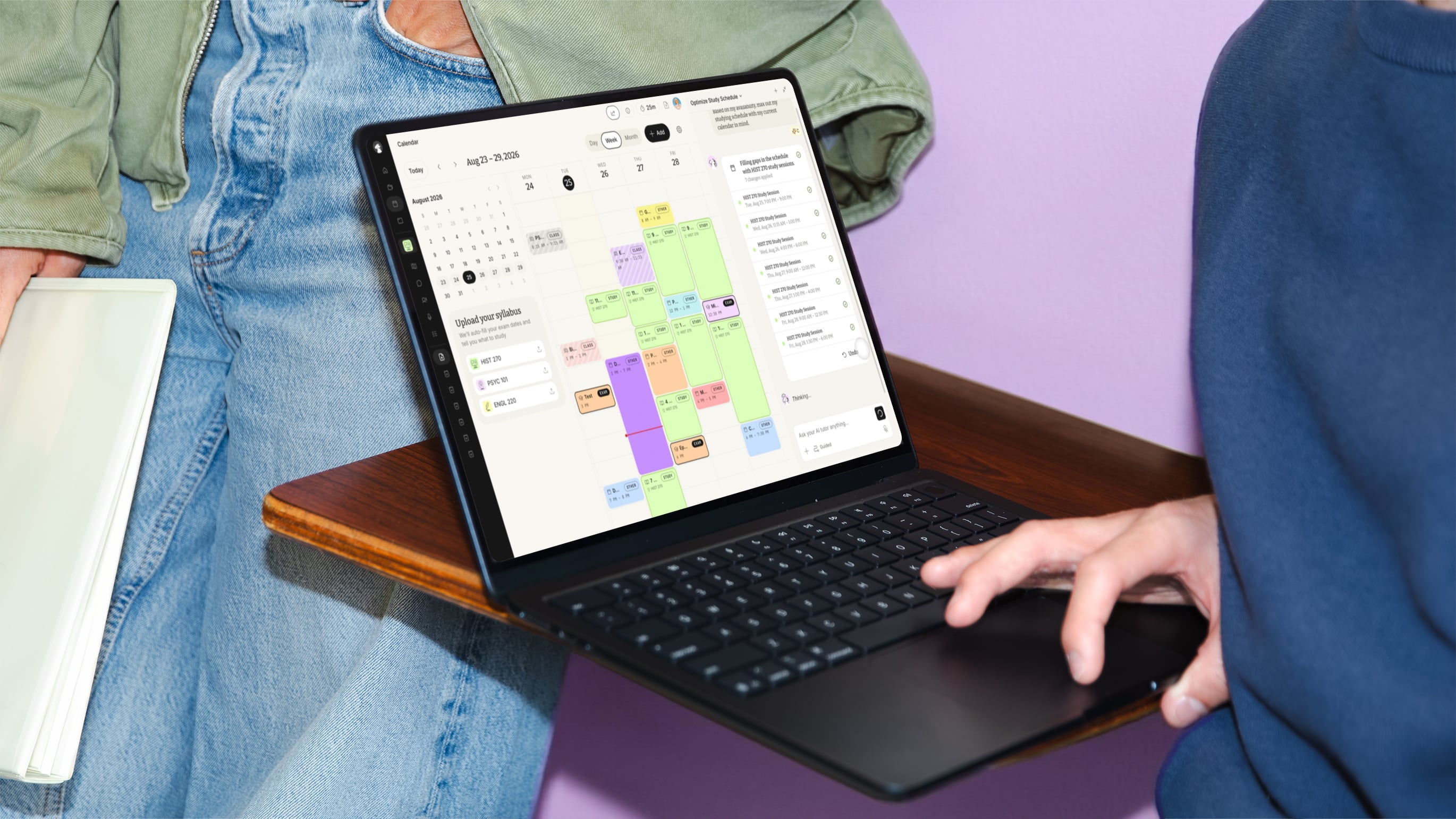
Introducing Active AI Literacy on StudyFetch
As students chat with our AI tutor Spark.E, every message is scored in real-time on two dimensions:
Prompting measures whether the student is providing context and asking specific questions. "I tried the product rule and got this answer, can you check my work?" scores higher than "tell me about physics."
Responsibility measures whether the student is seeking understanding, not just answers. "Can you explain why this formula works?" scores higher than "write my essay for me."
Together, these create an AI Literacy Score that appears as students interact with the tutor. The chat itself becomes the AI literacy teacher.
How It Works
After each message, students see instant feedback: what they did well, and a gentle suggestion for improvement. A student who types "help with chapter 3" sees a card suggesting they specify which concept they're stuck on. A student who shows their own work and asks a targeted question sees confirmation that they're prompting effectively.
This happens before they even hit send. As they type, the feedback updates, coaching them toward better AI communication in real-time.
The Scoring Rubric
Both dimensions are scored from 1 to 4.
Prompting: "Did you give the AI enough to actually help?"
Grade
What It Means
A (4): Clear intent, good context. The AI knows exactly what to do.
B (3): Clear enough to get a useful response.
C (2): Vague or missing context. The AI has to guess.
D (1): Unclear, random characters, or no real intent.
When study materials are loaded in the chat, short prompts like "Summarize this" or "Explain page 5" count as good prompting because the context is already there.
Responsibility: "Are you using AI to learn, or to avoid learning?"
Grade
What It Means
A (4): Shows own work, asks conceptual questions, uses AI as a thought partner.
B (3): Wants to understand the material, not just get answers.
C (2): Asks for direct answers with little effort shown.
D (1): Asks the AI to do their work without participating.
These two scores are independent. A student can write a perfectly clear prompt that asks the AI to write their essay (A on prompting, D on responsibility). Or they can show deep engagement while being vague about what they need (A on responsibility, C on prompting). Separating the dimensions lets us diagnose the right problem.
What This Looks Like in Practice
A on both: "I'm writing an essay on the causes of WWI. My thesis is that alliance systems were the primary cause. Can you help me think of a counterargument to strengthen my paper?"
Specific task, shows original thinking, uses AI as a thought partner.
A prompting, B responsibility: "Can you explain the difference between mitosis and meiosis in a table format? I have a test tomorrow and I keep mixing them up."
Clear and specific. Responsibility is B because they're asking for information rather than showing their own understanding first, but the intent to learn is genuine.
B prompting, A responsibility: "I think the answer to #3 is 42 but I'm not sure about my approach. Did I set up the equation right?"
Shows their own work and wants verification. Prompting is B because they could be more specific about the equation.
C prompting, B responsibility: "Help with chemistry."
Wants to learn, but the AI can't help effectively with something this broad.
B prompting, D responsibility: "Write me a 5 paragraph essay about the Great Depression for my history class."
Clear and specific request. But the student is asking the AI to produce their assignment for them.
What Doesn't Get Graded
Not every message needs a score. The system skips simple acknowledgments ("ok," "thanks," "got it"), very short messages, and quiz answer submissions. About 35% of messages fall into this category. The remaining 65% are graded.
What Students See
In-chat badges. Each graded message gets a letter grade badge. Tap it to see feedback explaining the score and how to improve.
Pre-send coaching. As the student types, a card above the input shows suggestions before they send. If the prompt is vague, the card suggests adding context. If it's specific and shows engagement, the card confirms it. This is the real-time coaching layer.
Scores over time. Students can view their prompting and responsibility scores across their last 100 messages to track their own progress.
What Teachers See
Teachers and administrators get aggregate views: average prompting and responsibility scores for a class over a selected date range, per-student breakdowns, and the ability to identify which students need help with prompting (coaching) vs. responsibility (a conversation about academic integrity).
Why This Matters
We built this system because it lets us measure what actually happens when students use AI to learn. At scale, across millions of messages, we can track whether students are using AI responsibly, whether they're communicating with it effectively, and whether those behaviors change over time. We can see improvement by student, by class, by education level.
That data has already shown us that responsibility is high across the board, that prompting is where students struggle, and that the gap between good and poor AI communication has real consequences for learning outcomes. We'll be publishing that research separately.
Active AI Literacy is our response. Students don't need to be told to use AI responsibly. Most of them already do. What they need is coaching on how to communicate with AI clearly enough to get real value from it.
Every conversation with Spark.E is a chance to practice that skill. The feedback is immediate, specific, and built into the flow of studying. Students don't take a separate course on AI literacy. They build it while learning their actual coursework.
We're preparing our students for an AI-powered workforce by teaching them to collaborate effectively with AI, one message at a time.
Privacy: No student message text, quiz questions, quiz answers, or student responses are included in any published dataset. All user identifiers have been salted and hashed. The published data contains only anonymized IDs, numerical scores, timestamps, and metadata. StudyFetch does not use student data to train AI models. This analysis was conducted on structured score data only.